3 Resorts in 3 Weeks: An Honest Guide to Skiing the Alps
Planning a multi-resort ski trip across the Alps is the kind of winter dream that looks effortless on Instagram – sweeping ridgelines, sunlit glaciers, border crossings on skis. The reality lives in the details: avalanche delays, peak changeover traffic, winding mountain roads, crowded reception desks, train schedules that don’t quite align. A three-week journey from Val d’Isère to Les Arcs to Zermatt isn’t just about covering more terrain. It’s about learning how to move through uncertainty.
Before You Arrive: Gear, Flights & Logistics
My best friend Charlie and I flew into different airports – Charlie took the train from Zurich to Milan, while I flew into Bergamo. From there, we had a bus transfer organized by one of our travel partners at Hegemon Travel. One thing I learned: leave the skis at home next time. Rentals and demo equipment are available at every resort, and hauling two sets of gear across borders, trains, and taxi trunks added unnecessary stress during transitions.
Before we even reached Val d’Isère, an avalanche caused fatalities and severe traffic delays on the mountain roads. Our bus ride took ten hours instead of five or six. On paper, Alpine transfers look simple. In practice, snowstorms, single-lane mountain roads, and peak Saturday changeover days routinely double travel times. Build that into your planning from the start.
This post is part travel narrative, part field guide – because in the Alps, how you travel matters just as much as where you ski.
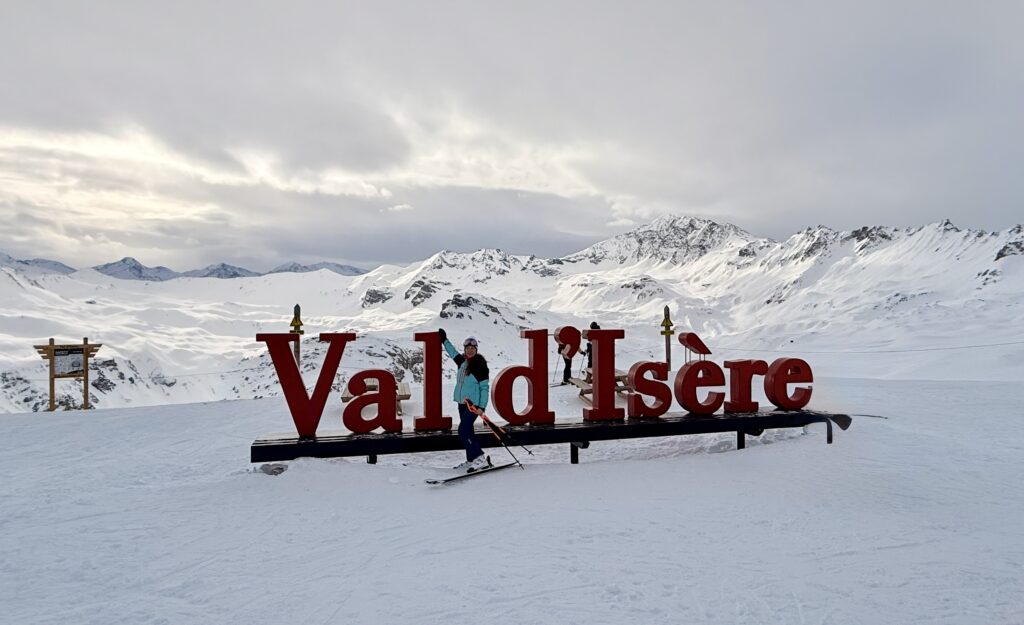
Week 1: Carving Into the Season at Val d’Isère, France
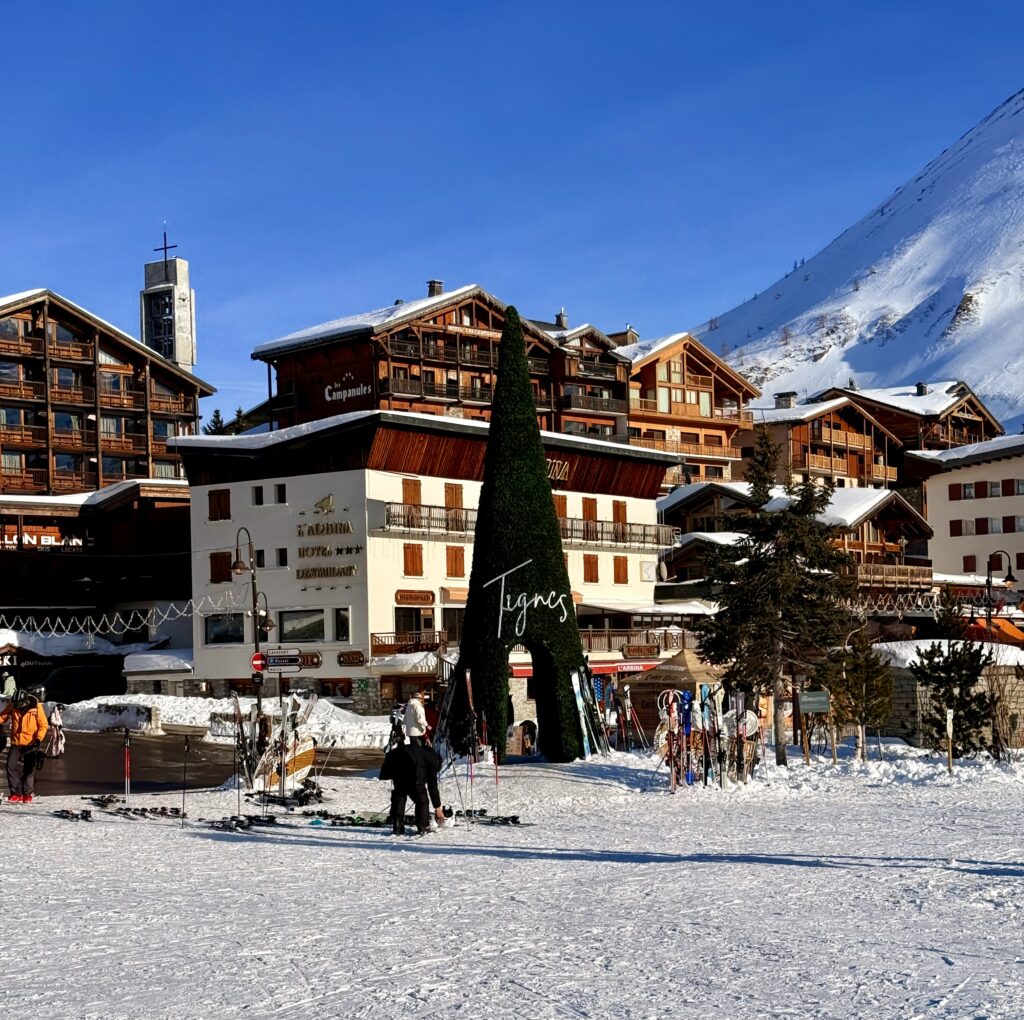
Val d’Isère – or just “Val,” as locals call it – sits in the Tarentaise Valley and is one of France’s most iconic ski resorts. As part of the enormous Tignes–Val d’Isère ski area, with over 300 km of interconnected terrain, 72 lifts, glacier access, and one of the most snow-reliable setups in Europe. The scale is impressive, but what makes Val so special is the varied terrain on- and off-piste, excellent Savoie food, and the kind of infrastructure that lets you focus on skiing, not logistics.
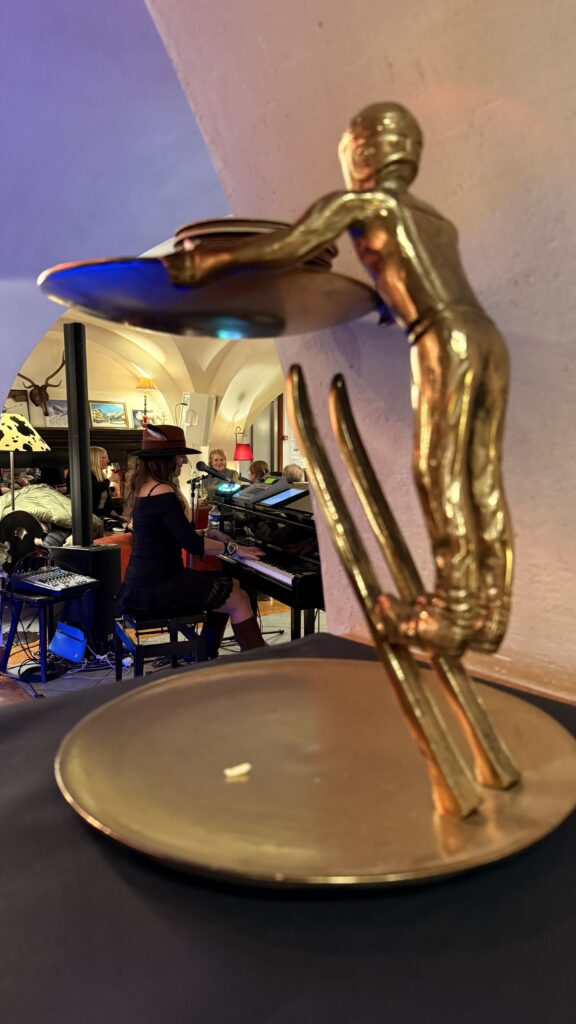
We stayed at Hotel La Savoyarde, right next to the ice-skating rink and the Rond Point des Pistes where the gondolas converge. The breakfast was excellent, the bar had a cozy fireplace with live music some nights, and the spa was put to good use after long days at altitude. Ski lockers were spacious with boot warmers, which sounds like a small thing until you’re pulling on warm boots in the morning.
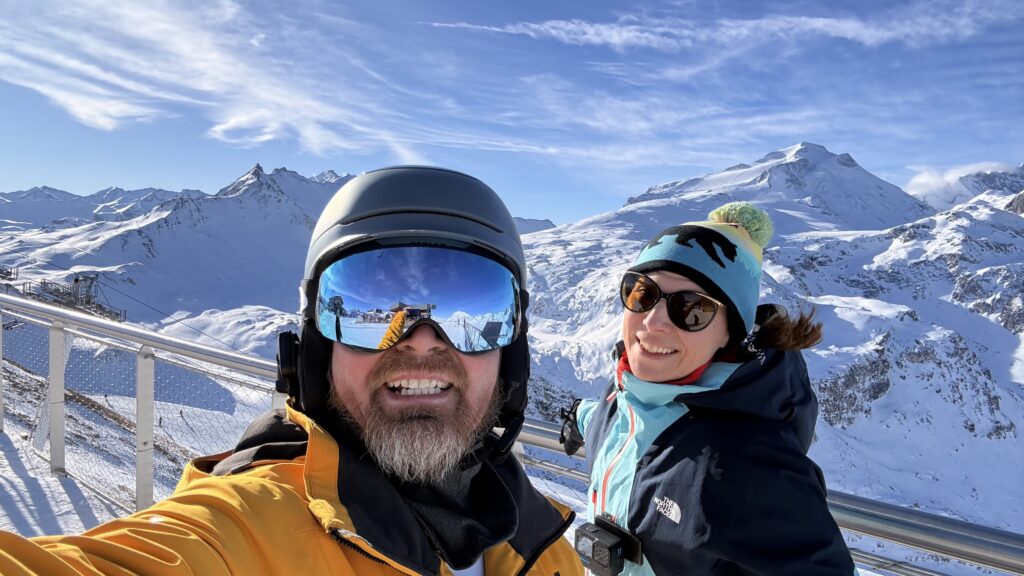
We had long, sunny days on the slopes, no queues at the lifts, private gondola rides, and the kind of après-ski atmosphere that makes you understand why people come back to the Alps year after year. Raclette at Le Blizzard, fondue at Bottleneck, crêpes and hot chocolate at the Rond Point – the food is half the trip when you’re in France.
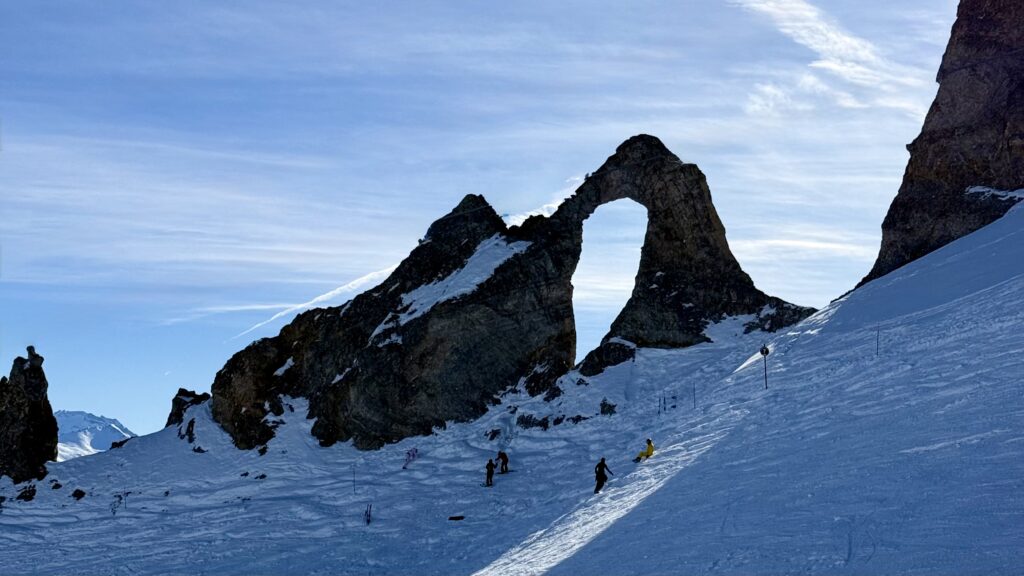
In Tignes, we found ourselves standing beneath the Aiguille Percée, a natural rock arch in the Vanoise National Park that feels like a portal – a quiet doorway sculpted over thousands of years by glacial pressure, wind, and meltwater. At 2,748m, the rock expands and contracts drastically with temperature shifts, and the result is extraordinary. Accessible via the Aiguille Percée chairlift from Tignes Le Lac, it’s easily one of the most memorable moments of the entire trip. It’s also the starting point for La Sache, a famously intense descent that doubles as a popular summer hiking route.
Highlights & Tips
- Altitude: 1,850m–3,456m altitude range; Funival funicular accesses 2,690m
- Terrain: 300+ km of interconnected terrain; 30 black, 41 red, 90 blue/green runs
- Best Runs: Face de Bellevarde (World Cup black) and OK and Arcelle (long, fast reds) are the standout pistes
- Longest Run: La Sache in Tignes – an intense, scenic descent ~ 10 km. starts near the Aiguille Percée arch
- Glacier: Glacier skiing from Grande Motte (3,456m) down to Val Claret (2,100m) – don’t skip it
- Season: Late November to May, one of the longest and most reliable seasons in Europe
- App: Download the Val d’Isère Ski App for maps, lift schedules, shuttle times, closures, and activities
- Shuttles: 4 free shuttles run around the village, to neighboring hamlets including Tignes 1800, and to/from the slopes
- Getting There: Chambéry (CMF) ~2 hrs, Geneva (GVA) ~2 hrs 45 min, Lyon (LYS) ~2 hrs 55 min. From Geneva or Lyon: SNCF train to Bourg-Saint-Maurice, then bus or private transfer. Check bensbus.co.uk, alpinbus.com, or alpinefleet.com
- Pass Perk: Your 6 to 15-day ski pass includes two free swimming pool entries
- Dining: Fondue at Bottleneck (Le K2 hotel), Le 1789 (tiny, reservation only), Poya, Le Garage, L’Etincelle (slope-side)
- Après Ski: La Folie Douche (open until 5 PM), Le Blizzard with La Luge downstairs for raclette, Cocorico (until 9 PM), Igloo Village for warm drinks and live music
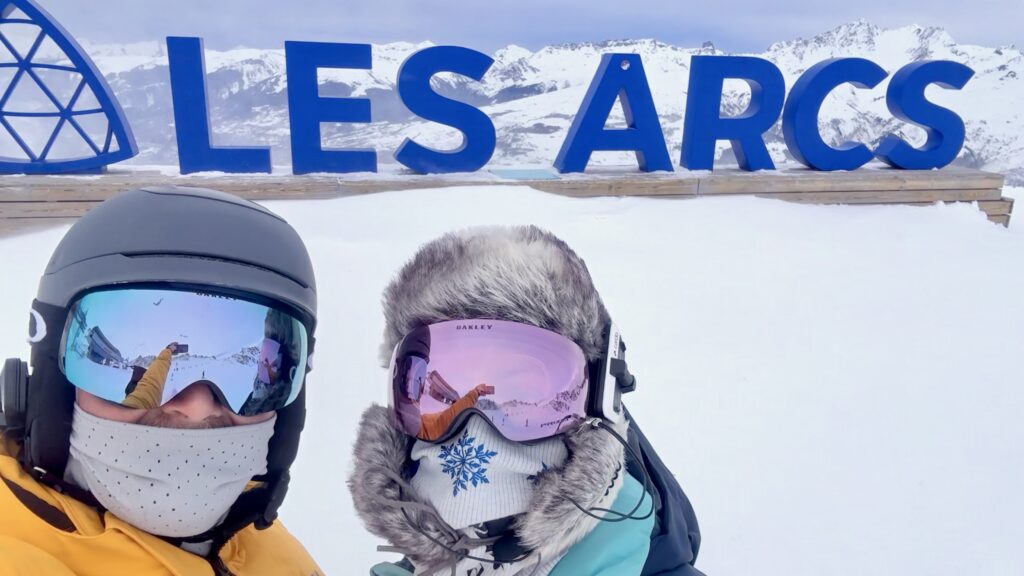
Week 2: Powder Play & Panoramic Rides at Les Arcs
Still in France, Les Arcs is part of the Paradiski area – linked with La Plagne via the Vanoise Express cable car – offering a combined 425 km of terrain. We arrived during Freeride Week, which added noticeable energy and significantly more people than we’d experienced in Val. The taxi from Val cost €230 and took nearly three hours instead of one, thanks to fresh snowfall and Saturday changeover traffic. Again: short Alpine distances are rarely short travel days.
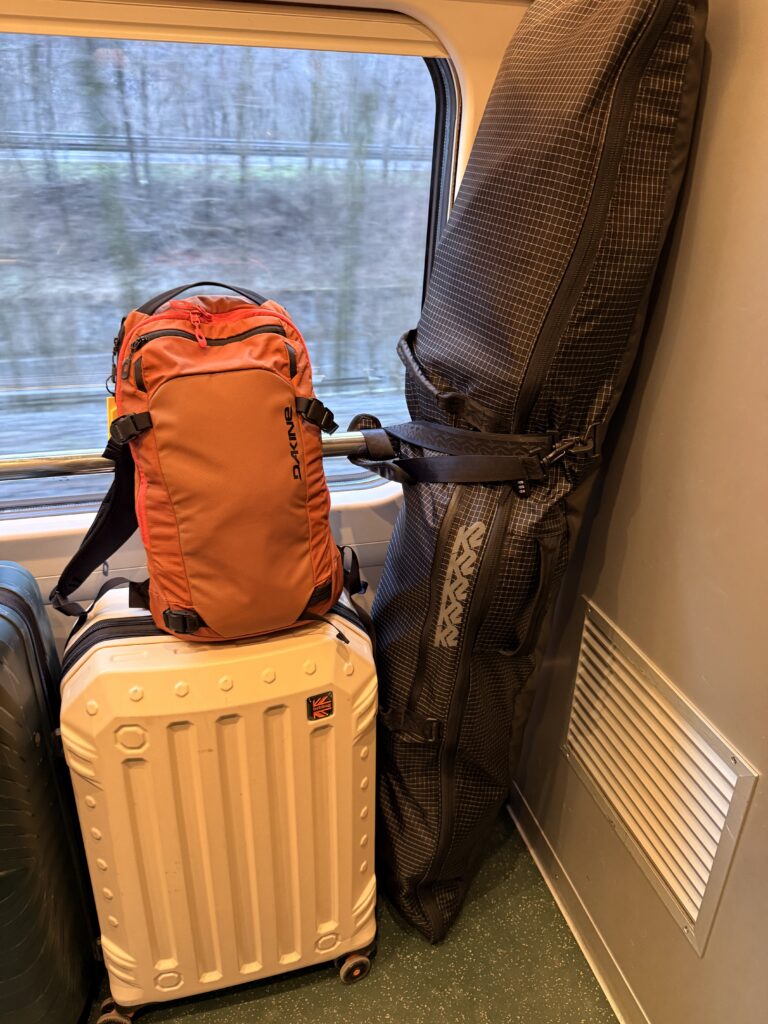
The alternative would have been a transfer to Bourg-Saint-Maurice, then the funicular up to Arc 1600, then a free shuttle to 1800. Since we were traveling with two snowboard bags, two suitcases, and two backpacks, we went straight to the hotel, dropped everything, and headed out to explore and collect our ski passes.
We stayed at Monarque Résidence Edenarc 1800 – a massive ski-in/ski-out residence with spacious apartments, full kitchens, ski lockers, and an indoor/outdoor pool. It’s practical and well-suited for families or groups who value space. That said, the scale changes the atmosphere in ways worth knowing before you book: check-in involved long queues, the spa was frequently crowded, and there’s no daily housekeeping (cleaning supplies are provided). Comfortable and independent, but less intimate than the smaller alpine hotels we experienced elsewhere.
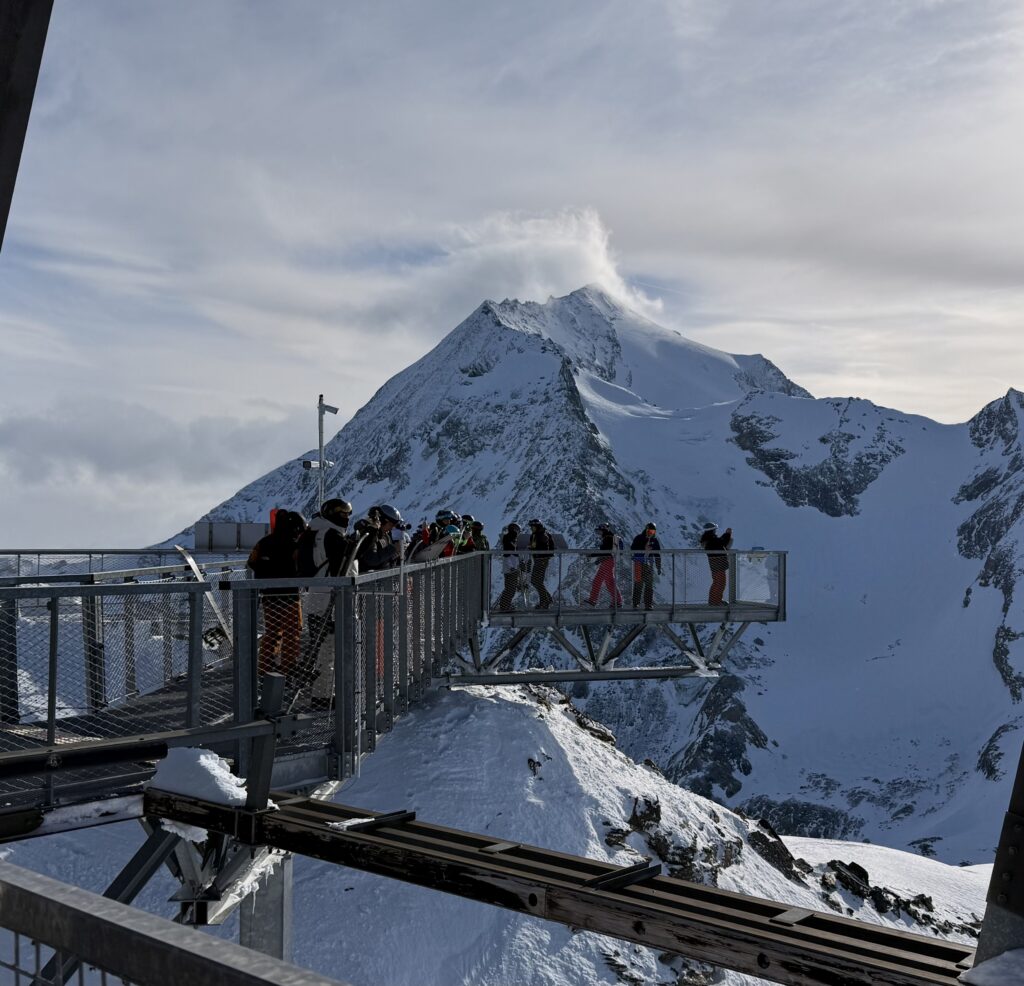
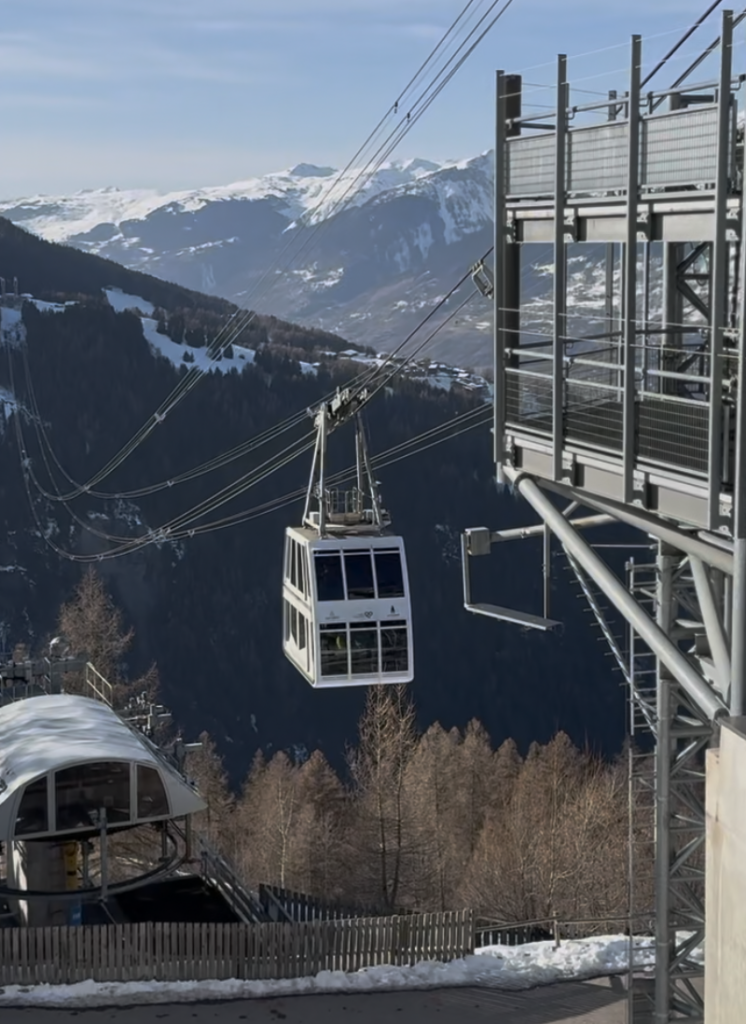
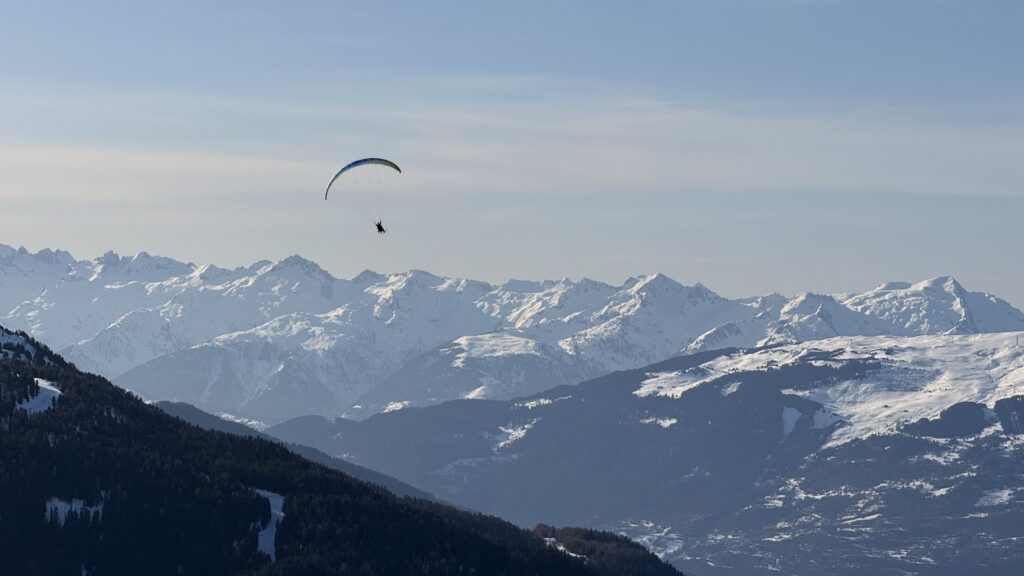
The skiing more than compensated. From the summit of Aiguille Rouge, the highest point in the area at 3,226m, you’re standing on terrain shaped by ancient ice. The descent into Villaroger – 7 km with a 2,000m vertical drop – is one of the most exhilarating runs I’ve skied. And the Vanoise Express, a double-decker cable car connecting Les Arcs and La Plagne in four minutes, is as much an experience as it is a lift. Two hundred people, floor-to-ceiling windows, views of Mont Blanc. It’s a party box in the sky.
Highlights & Tips
- Altitude: 1,200m–3,226m across Arcs 1600, 1800, 1950, and Arc 2000
- Terrain: 425 km combined with La Plagne (Paradiski); 152 green/blue, 79 red, 22 black runs within Les Arcs alone
- Longest Run: Aiguille Rouge – 7 km descent, 2,000m vertical drop, from glacier summit (3,226m) to the valley of Villaroger
- Activity: Aiguille Rouge zipline (€40–60): panoramic valley flight plus access to the glacier exhibit at the Varet terrace; paragliding paradise when the weather cooperates
- Season & Snow: High-altitude and glacier skiing; reliable snow in the upper sectors
- Season: Mid-December to mid-April
- App: Download the Paradiski YUGE App – includes live shuttle tracking, maps, and lift status
- Shuttles: Free shuttles throughout the resort. Allow up to 30 minutes between Arc 1800 and Arc 2000 – the area is large
- Vanoise Express: A double-decker cable car connects Les Arcs and La Plagne in 4 minutes
- Getting There: Geneva, Lyon, or Chambéry. TGV/Eurostar/Rail Europe trains arrive at Bourg-Saint-Maurice (Les Arcs) and Aimé (La Plagne); €30–40. Funicular from Bourg-Saint-Maurice to Arc 1600 takes 7 minutes (included with your ski pass)
- La Plagne: family-friendly, high-altitude, glacier skiing across 10 varied villages – worth a day trip via the Vanoise Express
- Wellness: La Piscine Aquatic Center: wellness and relaxation with views of Mont Blanc and the Tarentaise Valley
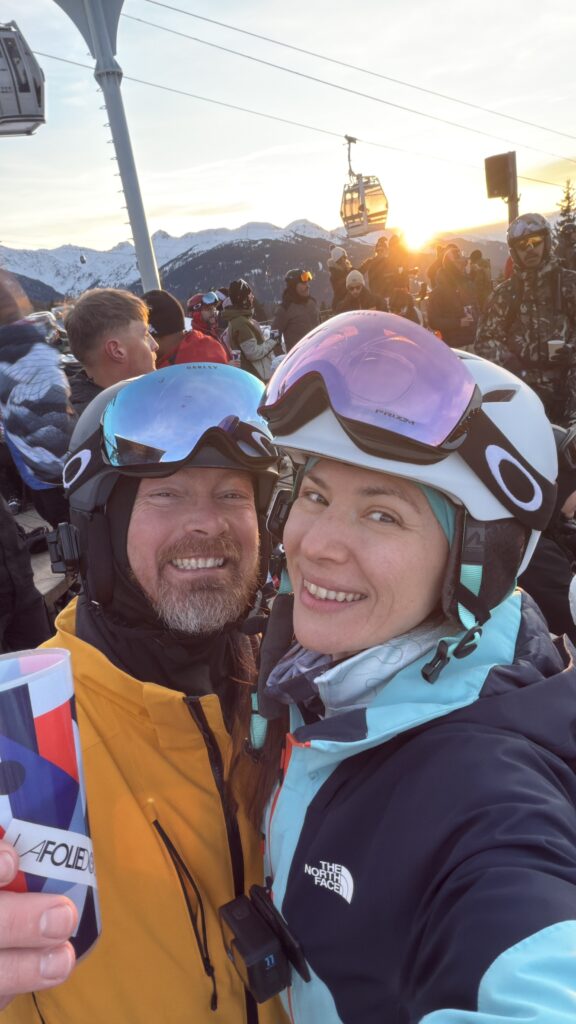
- Après Ski: La Folie Douche (until 7 PM – catch the sunset on the slopes), L’Arpette (until 4:30 PM), O’Chauds and more
Week 3: The Matterhorn at Your Back – Zermatt, Switzerland
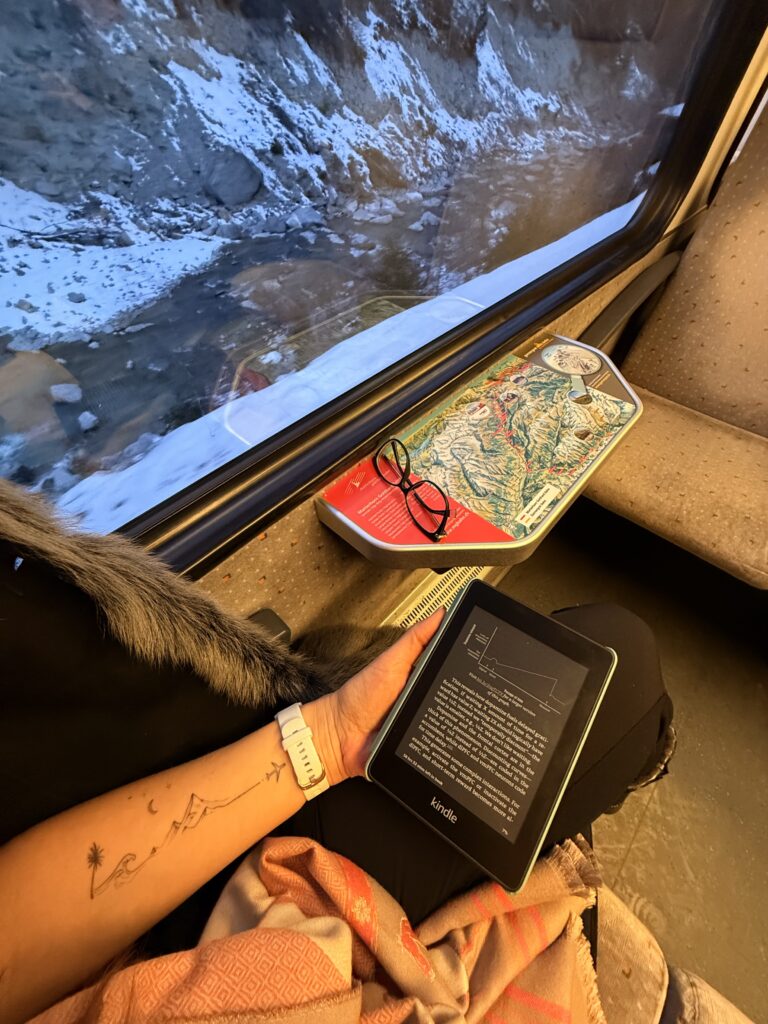
After two weeks in France, the journey to Zermatt becomes part of the experience. But from Bourg-Saint-Maurice, there is no direct route via the Mont-Blanc Express. We had to go through Chamonix to Martigny, then the Matterhorn Gotthard Bahn for the final stretch into Zermatt. Alternatively, you can book a segment on the legendary Glacier Express – one of the great scenic rail journeys in the world. All connections are best planned through Swiss Federal Railway (SBB).
We hired a car again (€370 and ~3.5h.) from Les Arcs to Chamonix, but there are buses (€50-100 p.p. and ~ 8h.) on SNCF. The train alternative required at least four separate connections, looping nearly back to Geneva. Not worth it. I wish we’d had a day to ski Chamonix, but maybe next season. We boarded the Mont-Blanc Express at 9:30 AM and arrived at Vallorcine by 11:25. We didn’t know about the small shuttle bus that connects to the Swiss train station, so we missed it and called an Uber. From there, train to Martigny, transfer to Visp, and the final train to Zermatt took a little over an hour.
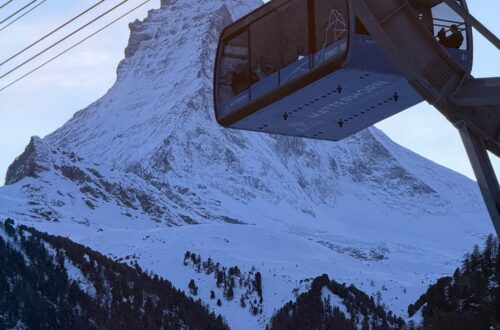
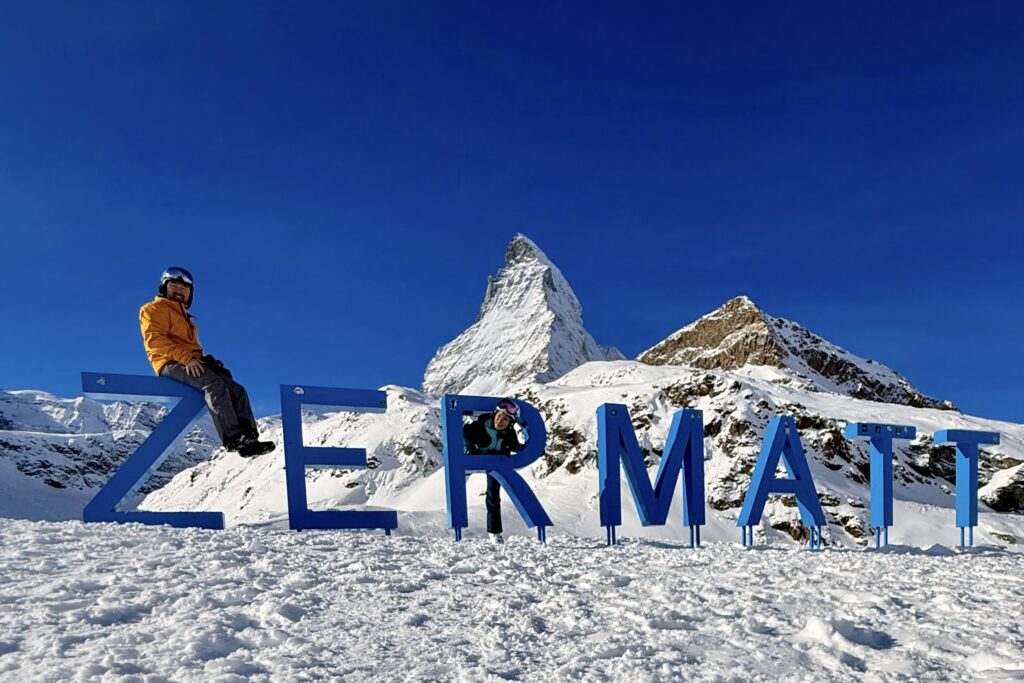
Arriving in Zermatt, everything feels immediately different. Car-free, pristine, quietly efficient, and dominated by one unmistakable peak. The Matterhorn doesn’t ask for your attention – it simply has it, from every angle, at every hour. The welcome drink we received at the hotel was most welcome after all the train rides and confusion.
We stayed in the Monte Rosa room at Matterhorn Focus Hotel, positioned right next to the Matterhorn Express gondola. Ski access was seamless, and the hotel’s recovery setup – which I’ve written about separately in The Ultimate Recovery After Ski – made the difference on back-to-back days at altitude. The property is thoughtfully designed, calm, and exactly the right scale after a busy week in the large Edenarc residence.
A 5-day ski pass wasn’t enough. We never felt a strong pull to cross into Cervinia – there was simply too much on the Swiss side – but it’s firmly on the list for next year. The key to skiing Zermatt well is not to ski it randomly. Choose a sector each day based on weather conditions, wind at altitude, and your energy levels. Ski that zone fully before moving on. Crisscrossing the mountain inefficiently is the fastest way to get tired from carrying skis and walking in ski boots, instead of actually skiing.
Highlights & Tips
- Altitude: 1,620m–3,883m. ; Matterhorn Glacier Paradise is Europe’s highest cable car station
- Terrain: 360 km of slopes shared with Cervinia, Italy; year-round glacier skiing at the higher elevation
- Best for Warm-Up Laps: Sunnegga–Rothorn: sunniest sector, wide cruisers, best classic Matterhorn photo angles
- Best for Views: Gornergrat: expansive reds and blues, some of the most spectacular views in the Alps. Ride the Gornergrat Railway at least once (included with your ski pass)
- Best for Carving: Riffelberg: long, rhythmic descents with uninterrupted Matterhorn views – ideal for carving
- Glacier Terrain: Plateau Rosa: glacier terrain connecting into Italy; wide-open pistes and dramatic ice formations
- Bad Weather Option: Furi zone: tree-lined runs close to the village – invaluable on windy or low-visibility days when upper lifts close early
- Longest Descent: ~25 km linked descent: Matterhorn Glacier Paradise → Trockener Steg → Furi → Zermatt; approximately 2,200–2,300m vertical drop when conditions allow
- Italy Day Trip: Cervinia, Italy: slightly lower altitude, sunnier slopes, excellent long-distance cruising – ideal for a cross-border ski lunch. We didn’t make it this trip
- Season & Snow: Year-round glacier skiing; reliable high-altitude snow
- Apps: Matterhorn (ski area), Skiguide (navigation), MeteoSwiss (essential for accurate high-altitude forecasts)
- Getting Around: 2 free e-buses (red and green line), 7:06 AM–8 PM; rush hour 8:15–9:30 AM. A 7-minute taxi from our hotel to the train station cost me 46 CHF, so plan ahead
- Lockers: Ski lockers at Gornergrat station: 2 CHF for 24 hours – brilliant idea and extremely useful
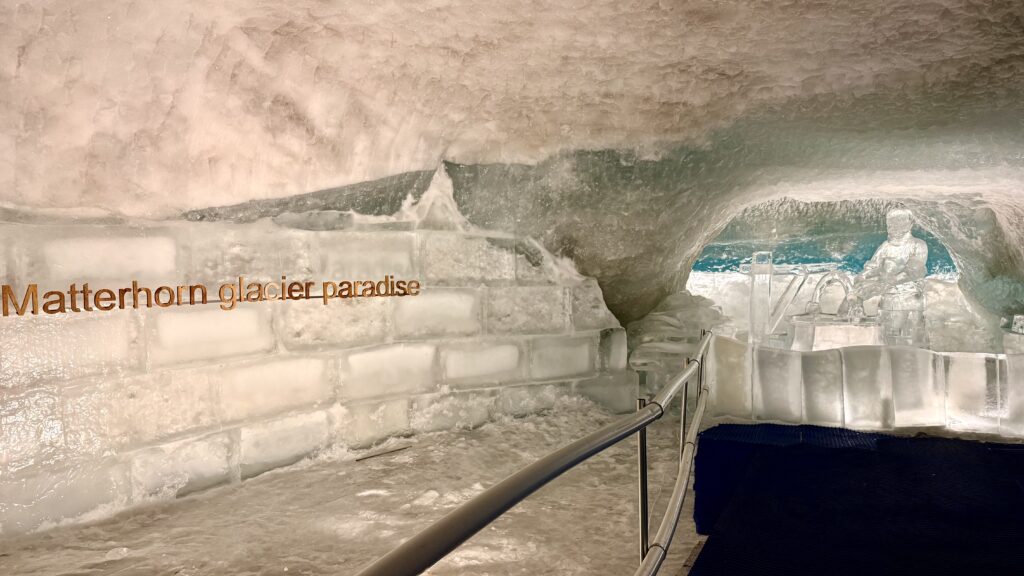
- Don’t Miss: Matterhorn Glacier Paradise observation deck; elevator descends 15 meters into the Matterhorn Glacier Palace, the world’s highest ice cave. Not just for skiers
- Dining: Stop for fondue at Iglu-Dorf, Gornergrat sector, between 12–2 PM; in town, try DuPont – the oldest restaurant in Zermatt, or the NostalChic train experience, just so many to list
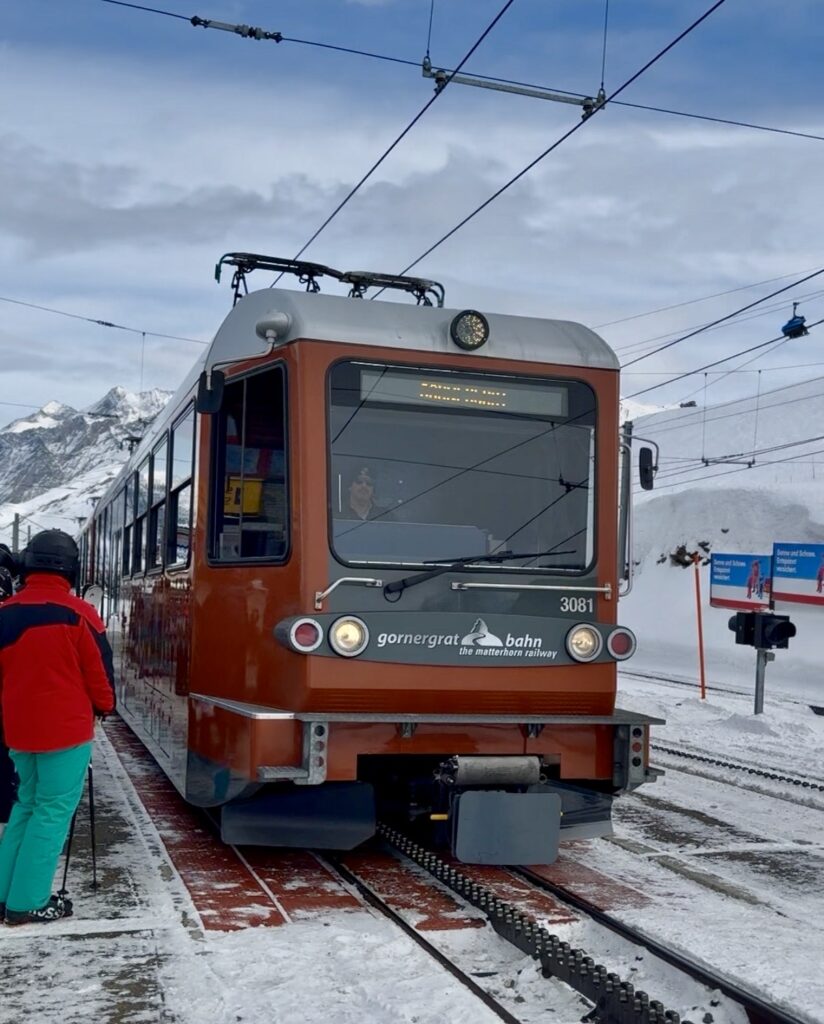
One Final Lesson: Getting Out
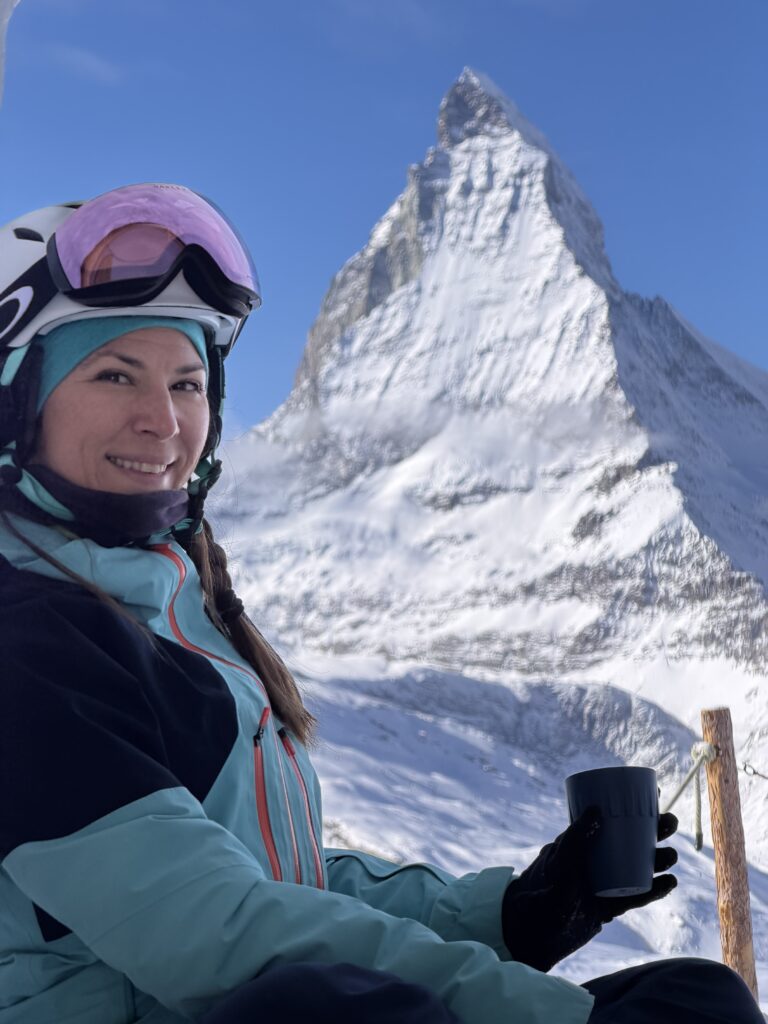
Departure day in Zermatt delivered the trip’s last logistics lesson. The free hotel shuttle doesn’t start until 8:00 AM. My train to Brig departs at 7:06. A seven-minute taxi from our hotel to the train station for 46 CHF felt like the shortest run of the entire trip. For comparison, the train to Brig was only 22 CHF. Connection to Domodossola, then normally another transfer to Milan.
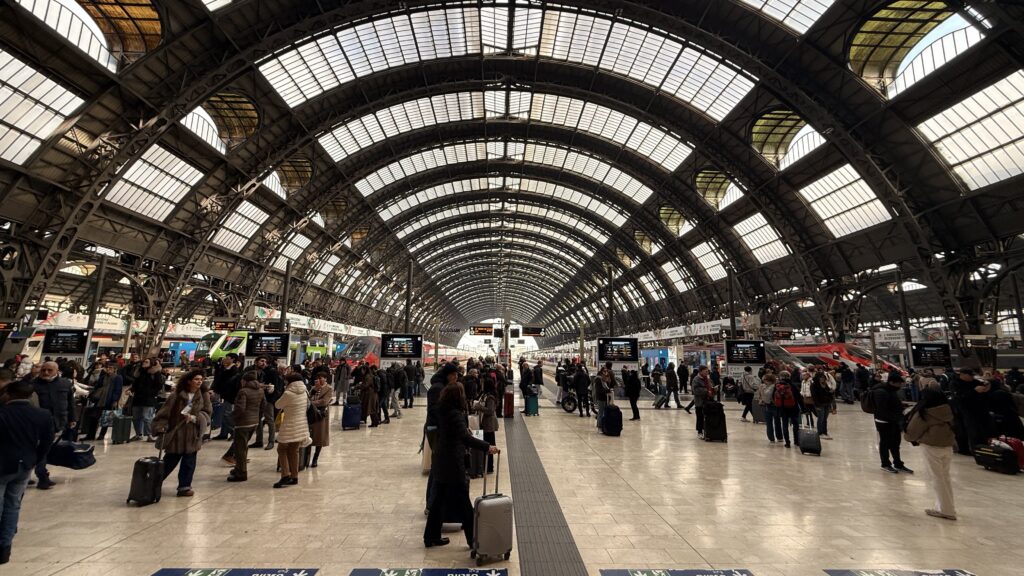
Except that morning, Italy was dealing with a rail strike. Service was interrupted. I stepped off in Domodossola with all my luggage, watched the departure board suddenly flip to “Milano,” and asked the conductor if I could stay on. I was already on the EuroCity. He let me buy a ticket on board – €75. Book your final transfer online in advance and you’ll pay significantly less. Plan the morning train around your shuttle schedule, not the other way around.
Total trip cost: Just over $20,000 USD for two people across three weeks, covering flights, all transfers, accommodation, ski passes, food, and après ski. Budget generously and build in a buffer for the transfers and surprises you can’t plan for – there will be at least one.
Before You Go: What I’d Tell You
Three weeks across three countries taught me that the best multi-resort trips are planned loosely enough to absorb the unexpected – and specifically enough that you’re not figuring out trains and taxis on the mountain. A few things I’d pass on to anyone planning something similar:
- Skip the gear haul. Demo or rent at each resort. Moving skis and boards across borders, trains, and taxis added friction at every single transition.
- Transfers always take longer than the map suggests. Saturday changeovers, snowfall, and mountain roads are not your friends. Build buffer days between resorts.
- Book all intercity and cross-border train tickets online in advance. On-board tickets cost significantly more, and during a rail strike, you’re at the conductor’s discretion.
- Download resort apps before you arrive: Val d’Isère Ski App, Paradiski YUGE, Matterhorn, Skiguide, and MeteoSwiss. The weather app matters more than most people expect.
- Carry Swiss francs for Zermatt. Smaller vendors and lockers often don’t accept cards.
- Ski by sector, not by ambition. In large resorts like Zermatt, picking one zone and skiing it thoroughly beats crisscrossing the mountain all day.
- At $20,000+ for two people over three weeks, this is a premium trip. It earns that price tag – but only if you travel intentionally.
Some trips end at the airport. This one didn’t.
Every transfer on this journey — the ten-hour crawl through avalanche traffic, the last-minute Uber in Vallorcine, the 46-franc taxi in the dark — reminded me that getting there is part of the story. For city-to-city rides across the world, I use InDrive: you set your own fare, choose your driver, and move on your terms. It’s the kind of flexibility a trip like this demands, and the kind I now refuse to travel without.
If reading this made you want to plan something similar, I can help. I’m a travel agent, and designing trips that balance ambition with real, ground-level detail is exactly what I do. Let’s build something worth writing about.
Message me or follow my next adventure — Asia, one-way, no return date — at @tanqitravels.