Going to India as a Yoga Teacher, but India Had Other Plans
There are journeys we plan, and there are journeys that feel as though they have been waiting for us.
My first encounter with Bhakti yoga wasn’t in India — it was in America, through a marriage that eventually ended and took the rituals with it. The words of the aarti faded from memory, and my path shifted toward asana and meditation – other forms of yoga more familiar to the Western world. If devotion remained, it did so quietly, beneath the surface, like a seed waiting for the right conditions to emerge.
It wasn’t until years later, during my 300-hour yoga teacher training that the clarity arrived with force: I needed to go to India. Not as a tourist or a practitioner seeking new techniques, but as a student willing to listen more deeply than before.
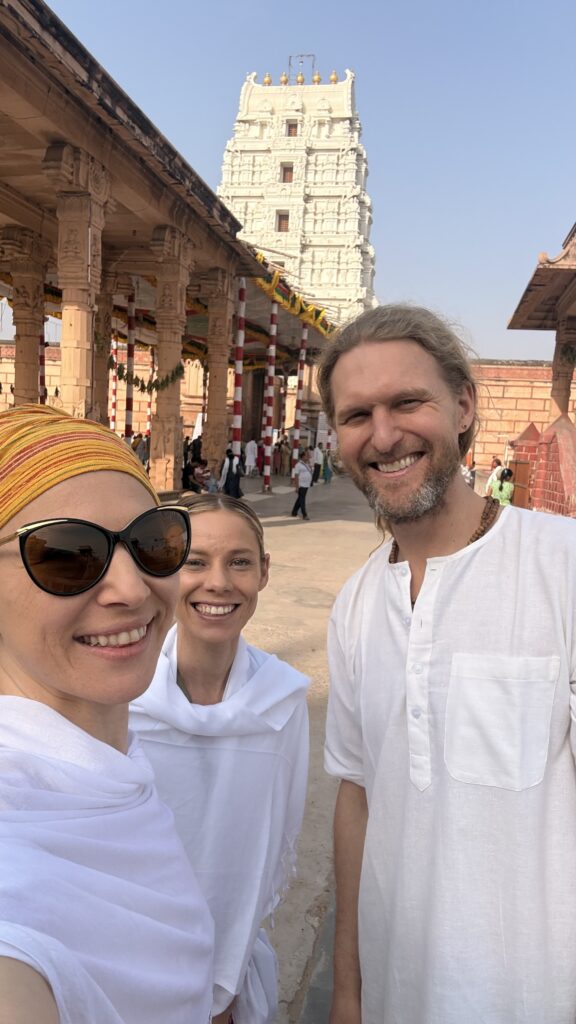
I found my way to a yoga immersion at the Jiva Institute for Vedic Studies in Vrindavan. Led by Juliana Larochelle – a deeply passionate yoga teacher whose approach bridges the physical and philosophical with rare integrity. The program was guided philosophically by Robert Lindsay, whose Bhagavad Gita class had the uncommon quality of making a 5,000-year-old text feel like a live conversation happening specifically for you.
The Streets Of Vrindavan Challenged Everything
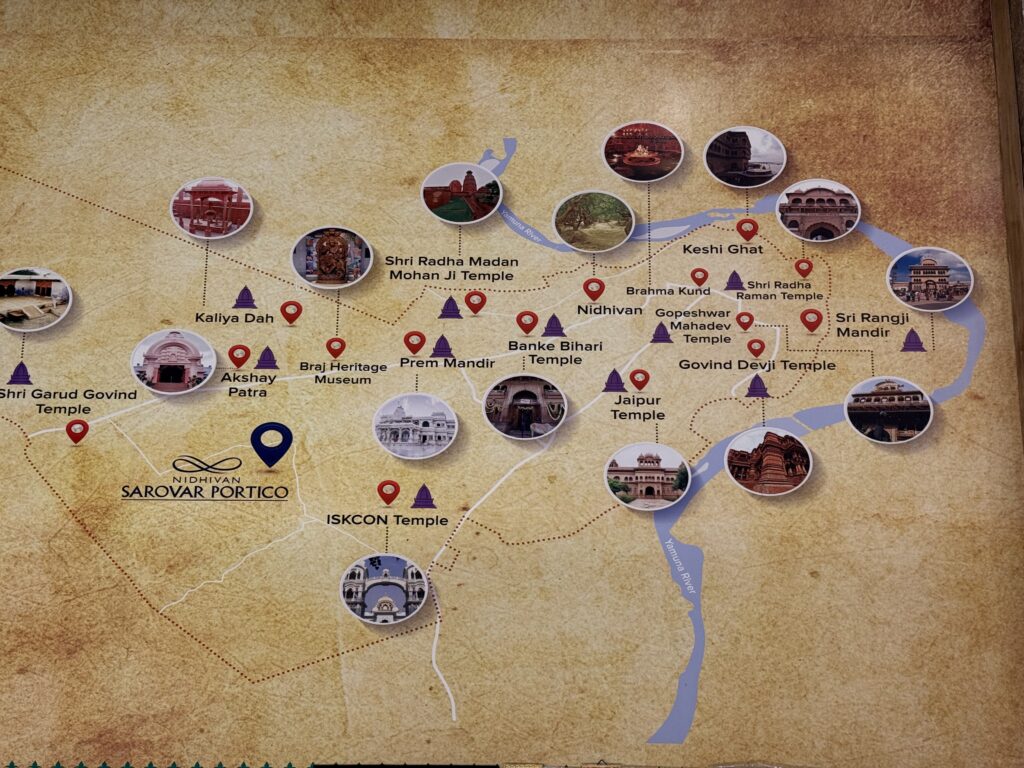
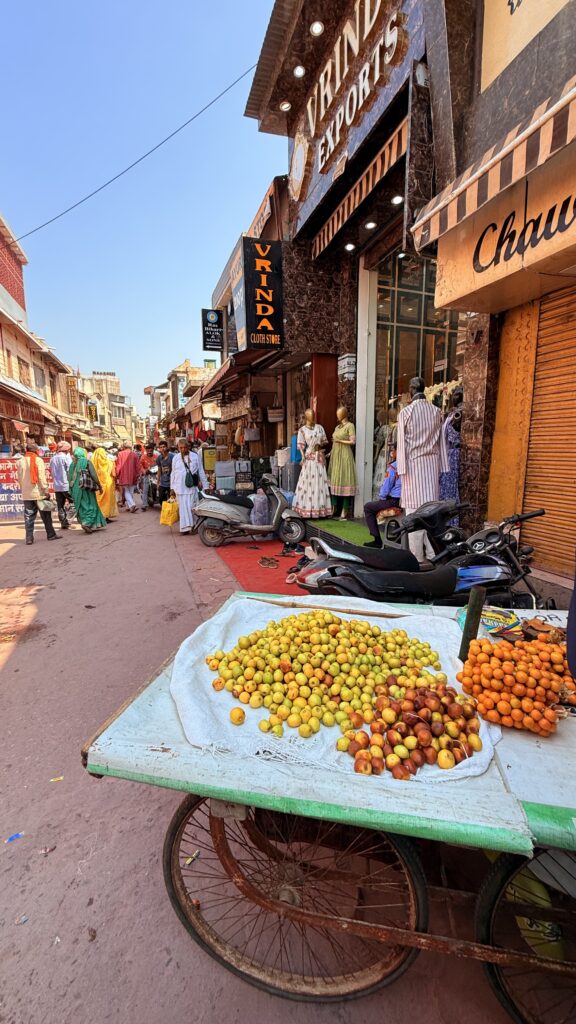
On our first morning, we followed Rob into the heart of the village for a brief orientation. He showed us where the closest Bank, ATM, shop, and restaurants are. He pointed out reputable places where we could exchange money, buy groceries, and drink chai. He explained that Vrindavan is a sacred pilgrimage site known as the childhood home of Lord Krishna and the circular Parikrama path around the town is undertaken by many barefoot devotees to visit some of the holy places.
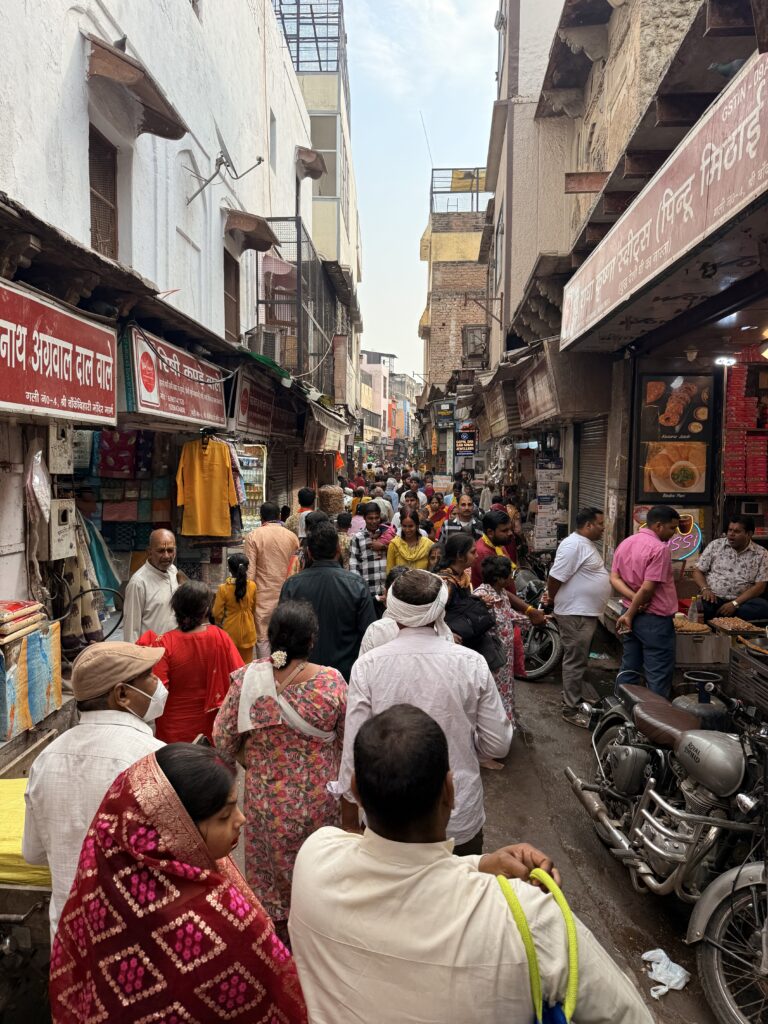
If the thought of walking through temples barefoot, the sensory overload on the streets, and the zero personal space makes you hesitate – I want you to know… That hesitation is exactly why you should go!
The constant sound of horns, the dust rising from the ground, causing sharp respiratory irritation. The smell of sewage mingling with incense. Monkeys, cows, and dogs being part of the traffic. It is overwhelming in a way that quickly activates your stress response system. A few people in the group felt ill just a couple days into the retreat with a dry cough often called “pollution cough.”
I slowly understood that Vrindavan however, is not what you see outside, but what awakens within despite of the chaos.
A City Built Around The Divine
Vrindavan is a town said to hold more than 5,000 temples. But here, devotion doesn’t stay inside temples. It spills into the streets, and into every glance, every greeting of Radhe Radhe, spoken not just as a habit, but as remembrance. A quiet recognition of the divine in one another. Devotion here is not contained. It is not curated. And it will not wait for you to feel ready.
The temples of Vrindavan are uniquie for their focus on Radha-Krishna bhakti, they are centers for daily devotion – and no two feel alike. Some are intimate and ancient, barely larger than a single room, where a lone flame burns before a deity garlanded in fresh flowers and the air is thick with incense and whispered prayer. Others are vast architectural statements – luminous white marble rising against the sky, with aarti ceremonies so immersive that light, sound, and movement cease to be separate things entirely.
Parikrama is a sacred act of walking in devotion – circling the holy land as a moving meditation, where each step becomes an offering and a remembrance of Krishna. Our group embarked on that 7 mile (11km.) walk on Ekadashi at 5 AM. Ekadashi is an auspicious day (tithi) devoted to purification and heightened spiritual awareness. That same walk is believed to carry deeper potency when done on that day because the mind is quieter, the senses more refined, and devotion more easily felt.
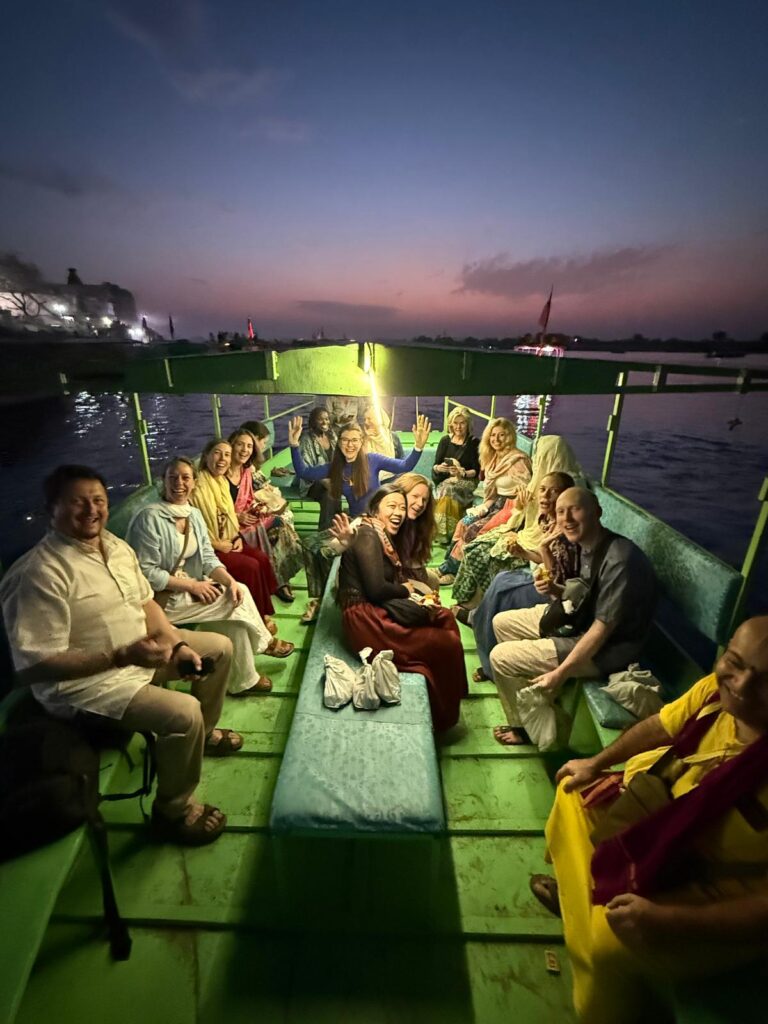
People arrive to the banks of the Yamuna river, at dawn and dusk not for tourism but to express their relationship – offering flowers to the water as one might greet someone they love. Standing there, watching, you begin to understand that in Vrindavan, the sacred is not a destination. It is the atmosphere itself.
The Temple That Broke Me Open
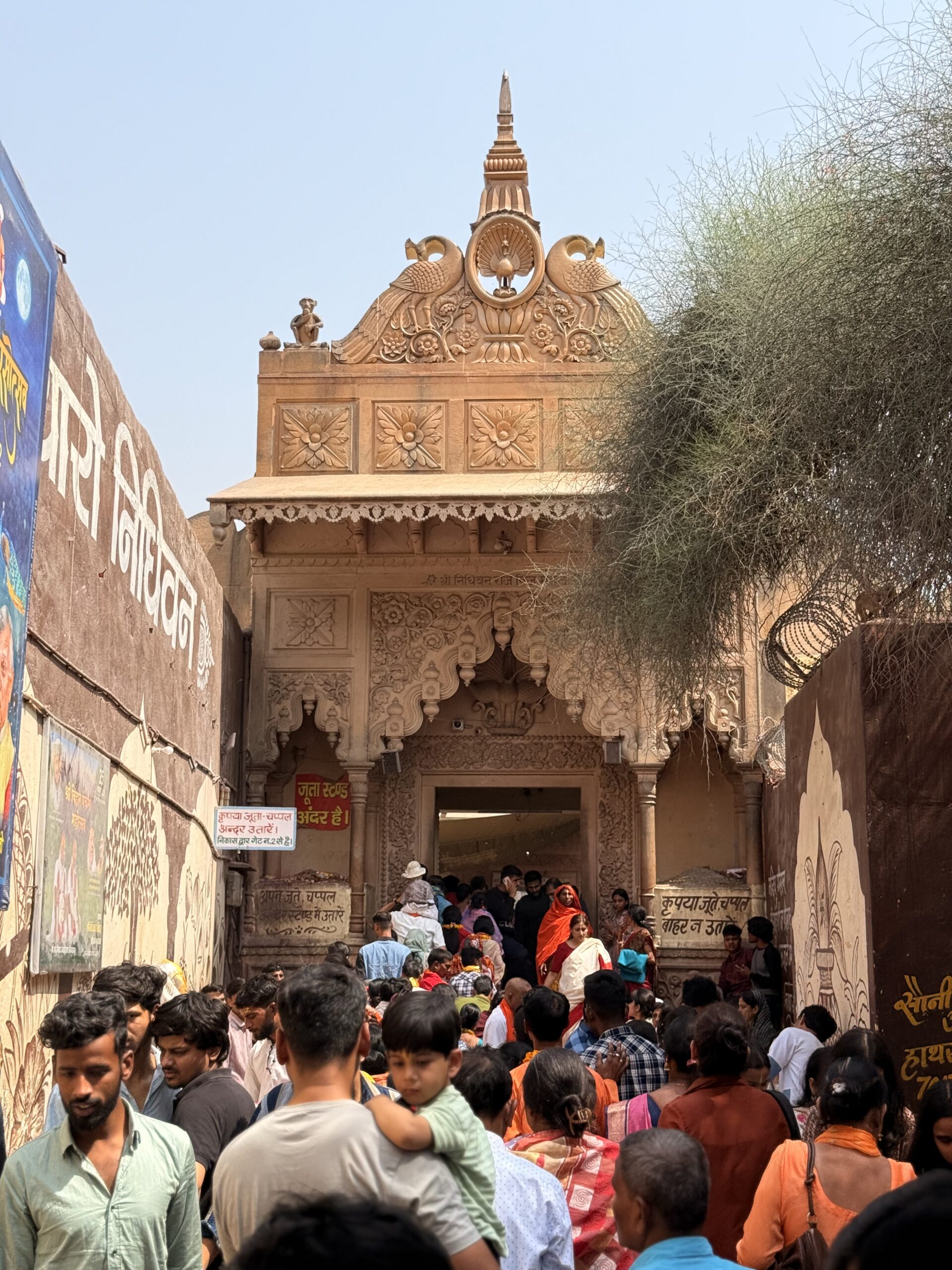
At Nidhivan Temple, I found myself in a crowd so dense that breathing became a conscious effort. Bodies pressed forward. Feet stepped onto toes. The air felt thin, as though it had been consumed by the sheer number of people occupying the space. I remember thinking, with a mixture of confusion and discomfort: How can this be devotion?
My entire understanding of spirituality had been built on quiet, stillness, and a certain kind of order that signals something sacred is near. Devotion, in my experience, had been something gentle and contained. Here, it was anything but…
And yet, when I looked into peple’s faces, I saw something I could not dismiss. There was softness.
It was in that tension, between what I expected devotion to look like and what I was witnessing, that something within me began to crack open.
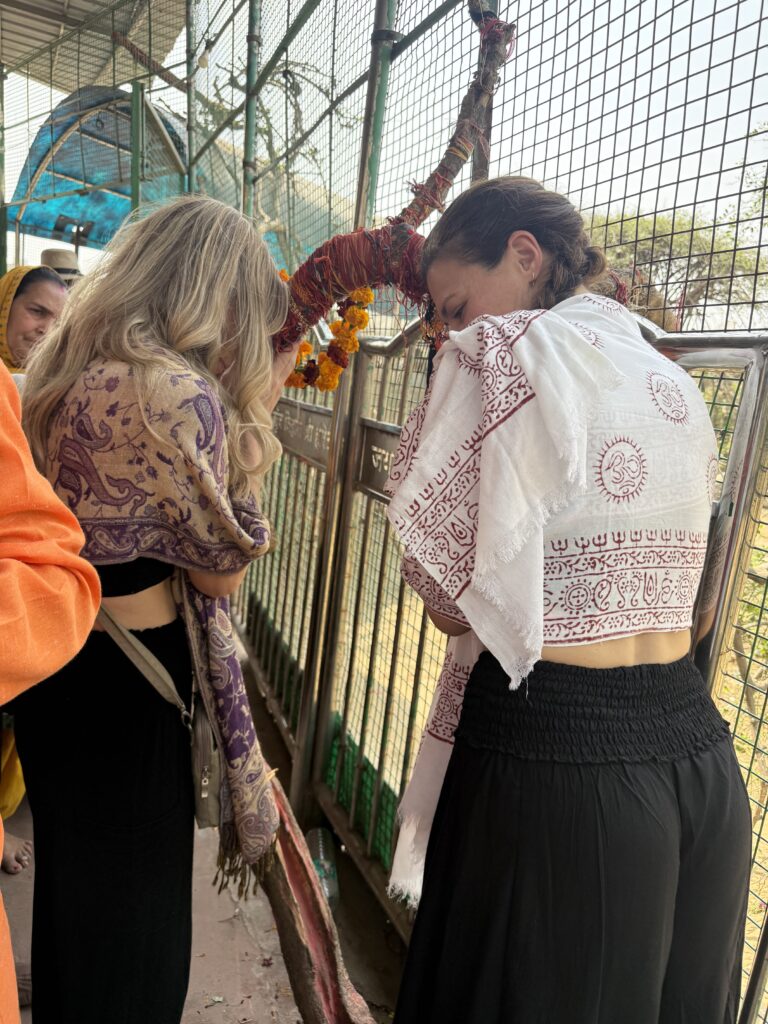
Krishna’s words to Arjuna arrived with a clarity they had never carried before: the world will not arrange itself into stillness so you can find peace. Yoga is not about creating perfect conditions. Yoga is the cultivation of equanimity within imperfect ones. In that temple, pressed on all sides, I finally felt it.
The Collapse of a Western Yoga Identity
That moment marked the beginning of what I can only describe as a complete surrender. The version of me shaped by years of practicing yoga in the West began to feel incomplete.
In the environments I was accustomed to, yoga often took place on clean mats, in temperature-controlled rooms, with carefully curated playlists and an emphasis on alignment, sequencing, and physical expression. There was value in those practices, certainly, but they existed within a framework that subtly reinforced comfort and predictability.
In Vrindavan, none of that existed.
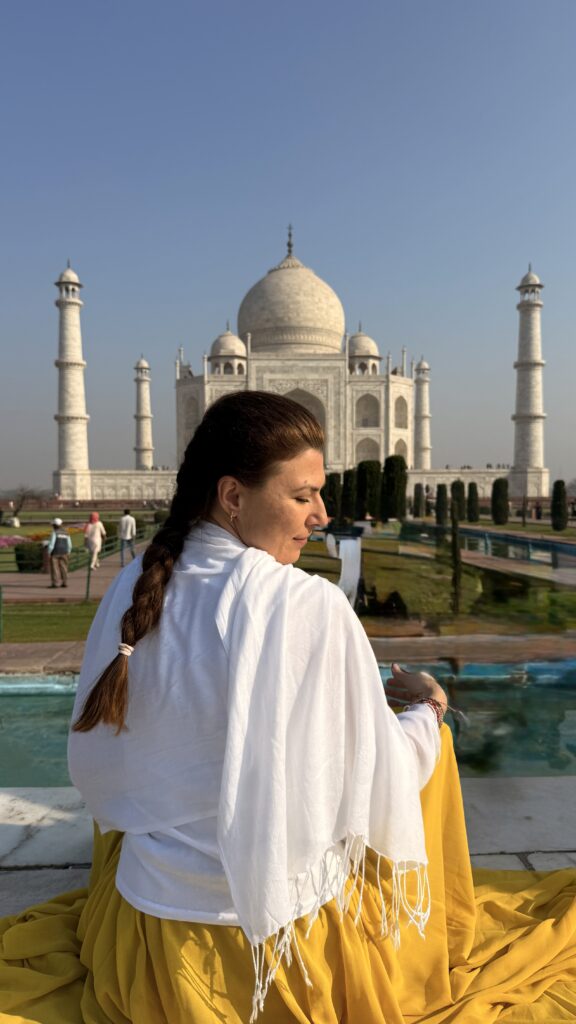
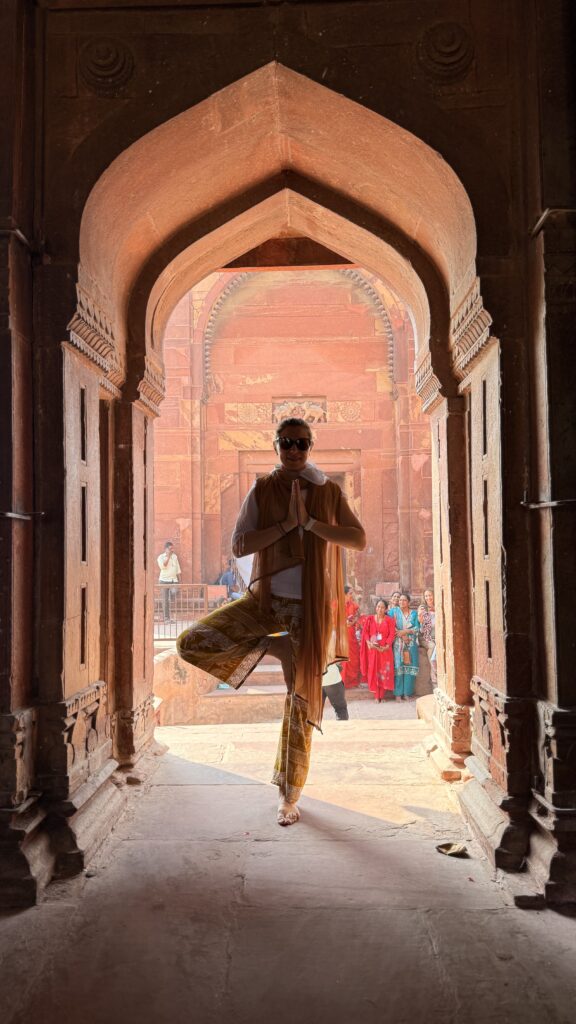
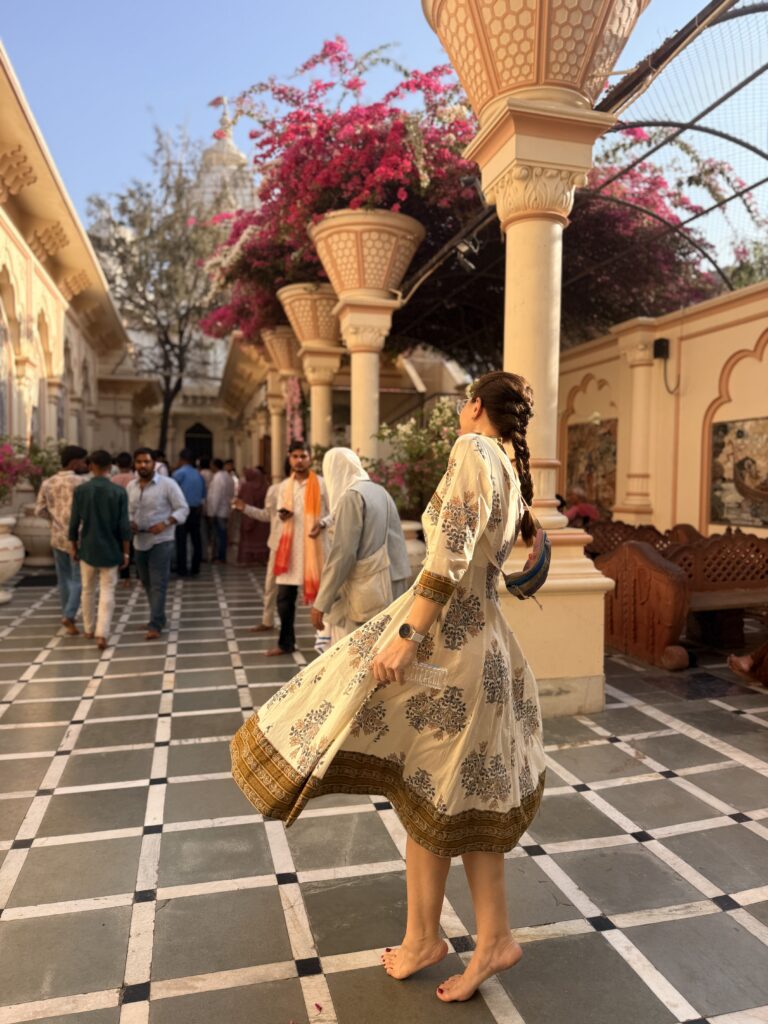
We walked barefoot everywhere – through the ashram, the stores, the streets, the temples. At first, I resisted. The ground felt cold, unclean, unpredictable. But gradually, that resistance softened. The feet became dirty. The need for control lessened. Devotion, I realized, was not dependent on external order. If anything, it seemed to thrive in the midst of chaos.
Life Inside the Immersion
Founded in 1994, the Jiva Institute of Vedic Studies is one of India’s leading centers for Bhakti Yoga and Vedic philosophy. Guided by Satyanarayana Dasa Babaji, it attracts students and scholars from around the world to study Vedic Psychology, Ayurveda, Feminine Spirituality, and more. My teachers studied under prof. Edwin Bryant at Rutgers University about 10 years ago, where Babaji was a visiting professor during his career in the US.
The Bhagavad Gita we studied was translated and annotated by Babaji himself – a Sanskrit scholar who has spent over four decades living and studying in Vrindavan, and who was honored by the President of India for his contribution to Vedic philosophy. Reading his commentary along with Robert’s increasingly passionate perspective felt less like studying a text and more like being handed a key.
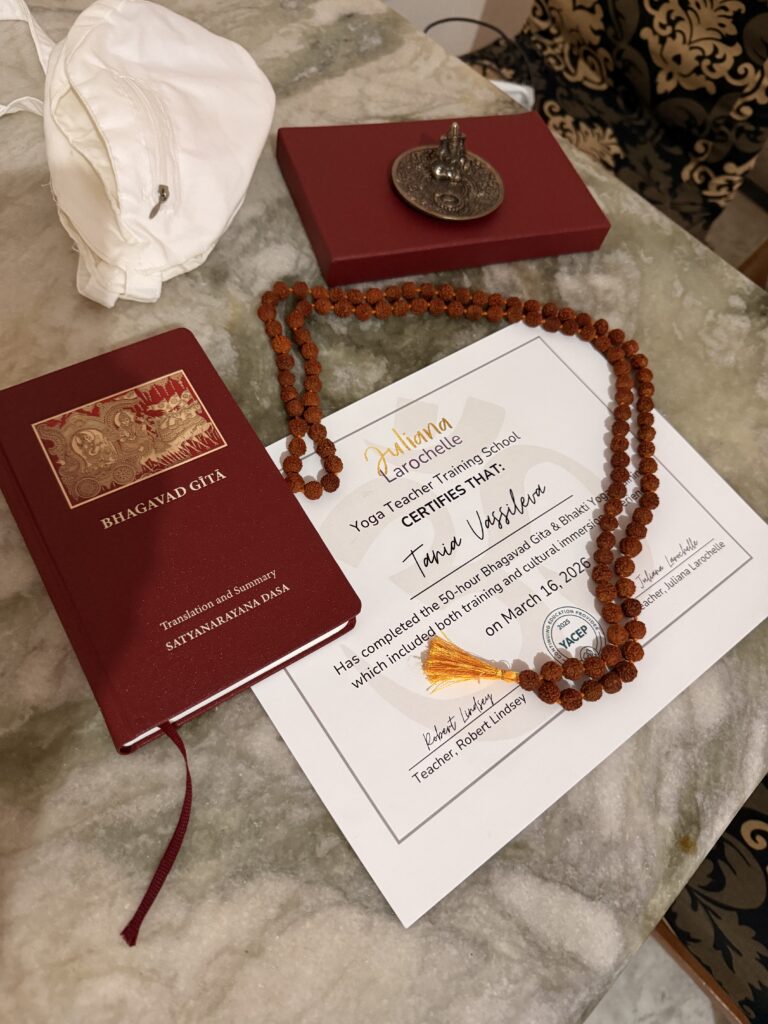
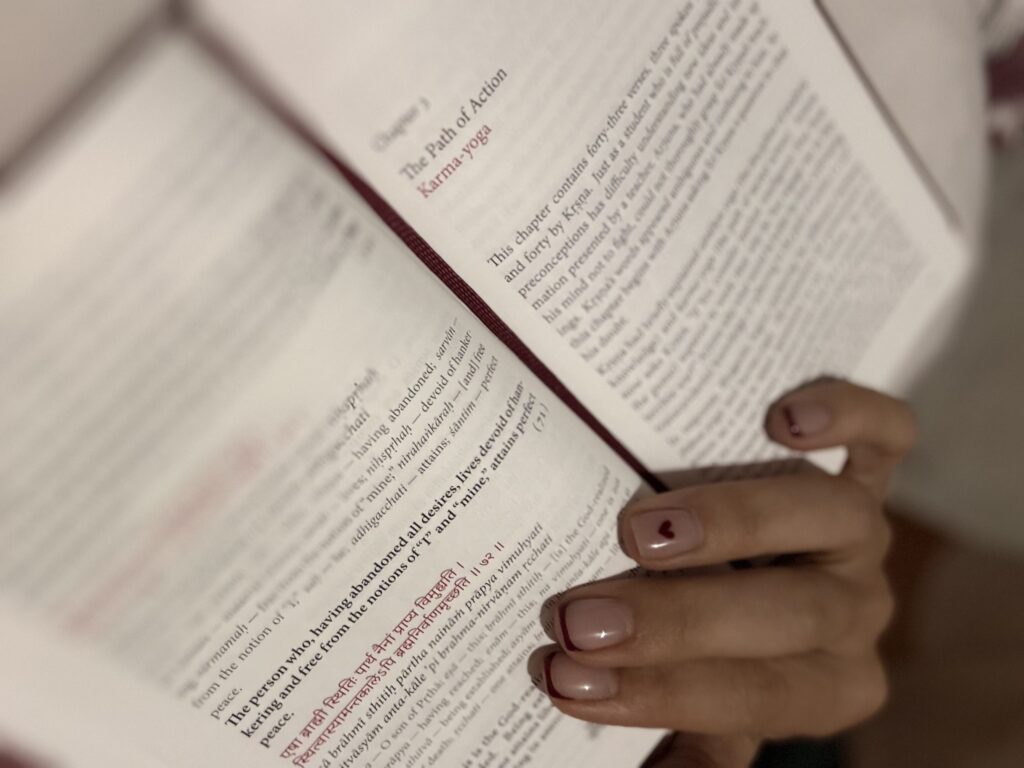
Our days followed a rhythm that felt intentional but not rigid. Meditation before dawn extended by one minute each morning – a subtle invitation to remain present just a little longer than the mind preferred. Yoga classes varied in style and depth. Each one closed with a dharma talk and a partner exercise: standing in Tadasana, making eye contact, witnessing another person’s experience without comment or interpretation. That was, for many people much more difficult than any physical posture.
Rob’s Gita teachings were dynamic and disarmingly humble. One of his simplest questions stayed with me: Who here needs to hear something more than once to understand it? Every hand went up. Including his. It was in that humility that the teachings found their way in.
Then the Bhagavad Gita began to read differently. Arjuna is no longer just a distant figure on a battlefield. He is the part of us that hesitates, questions, resists, and seeks clarity in the midst of confusion. He is the purusha — the eternal witness that exists beyond the fluctuations of the mind and the temporary nature of the body. And just as Arjuna forgets who Krishna truly is, we forget our own connection to the divine. We identify with the roles, the narratives, the identities we construct and defend.
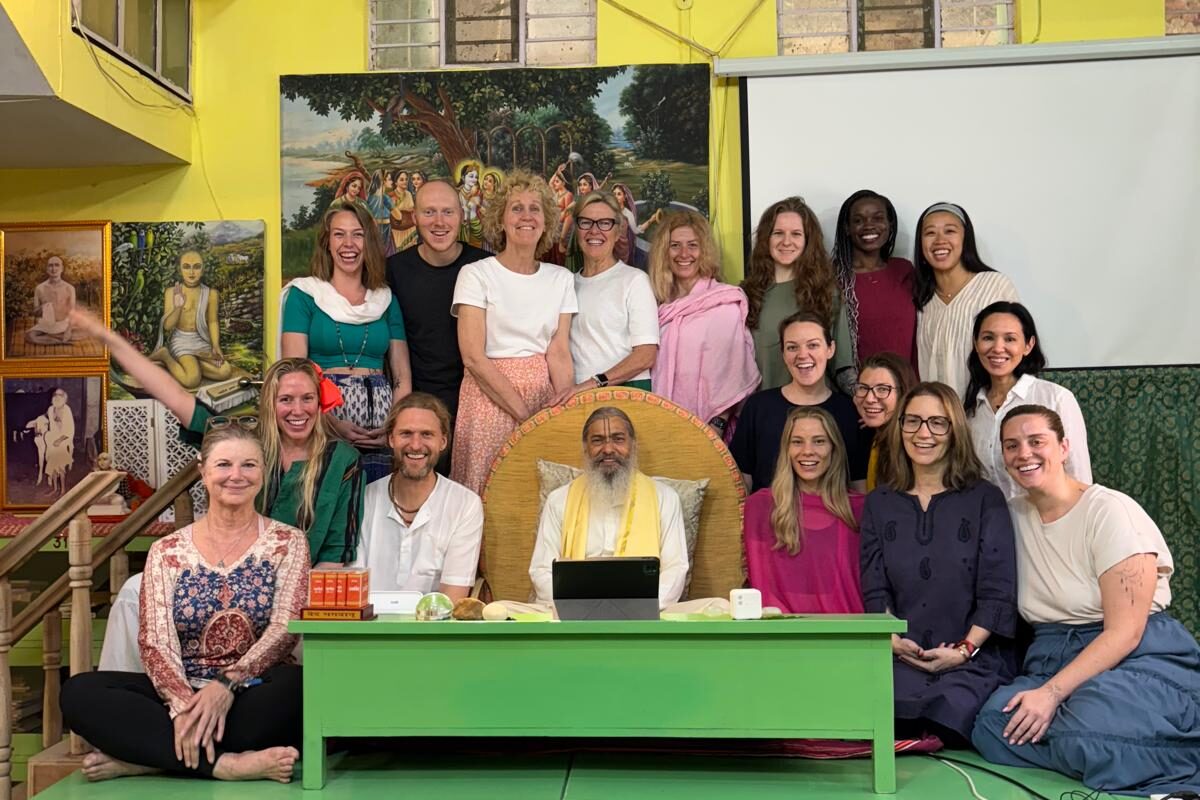
Reading the Gita in Vrindavan, in that context, with that teacher, the structure of what I had understood as “self” began to loosen. The certainty I had carried into the experience softened. It was not dramatic. But it was unmistakable. The more I understood, the less I was sure I had ever known — and for the first time, that felt like progress.
All proceeds from the immersion were donated to the Jiva Farm for the ongoing legal battle to save one of the last remaining green spaces in an area rapidly overtaken by construction. Planting trees there felt different from any service I had offered before. Working the soil, standing under fruit trees while cows grazed nearby – it brought a sense of connection that extended far beyond the individual. Seva, in that context, was not an action. It was a relationship.

The Ashram Outside The Immersion
During the summer semester (May – September) the ashram is pretty quiet with just a few devotees who permanently live here. Babaji’s daily lectures are held in a small private setting, one class in the morning and one in the evening. There are usually 3 meals per day, and kirtan is at 5 PM. Wi-Fi is generally available, the showers have hot water and the rooms in the guest house are spacious with AC.
From October to March the main semester is usually busy with many students coming for the full 6 months or for part of the program. Babaji usually teaches 2 classes a day during the week. On Sundays the Bhagavad Gita class is in Hindi, but it’s translated in English and Spanish on Zoom at 10:30 AM. You will find a wonderful library in the basement with some unique books that you can borrow to read on site.
Here is a list of learning opportunities available to you at the Jiva Institute for Vedic Studies:
- Vedic Literature by Satyanarayana Dasa Babaji in English every weekday – recordings of past lectures available online.
- Vedic Psychology with Joshika Devi – Fridays & Saturdays live classes, Book club live meeting on Thursdays, and courses available online.
- Feminine Spirituality Courses with Jaya Devi will help you learn what’s been missing in your life and how to bring back the balance.
- Ayurveda with Babaji’s brother Dr. Partap Chauhan – you can also visit Jivagram Clinic for Panchakarma treatments.
Important Notes: Smoking, intoxicants, alcohol, and meat consumption are strictly prohibited. in the ashram. Be mindful of others and keep the noise level down, and ensure your valuables are kept secure. The institute is not responsible for lost items. Ask about Student Visa information before you go.
Before You Go: What I Wish I Had Known
If this is calling you, here are the things I wish someone had told me before I arrived.
India is safe, but arrive with an open mind. Your physical practice matters far less than your willingness to be still, to be uncomfortable, and to be wrong about things you were certain of. Give yourself at least a day or two before the immersion begins and simply walk. Let the city disorient you before you try to understand it.
Delhi is your gateway – Vrindavan is approximately a 3-hour drive from Indira Gandhi International Airport. The best time to visit is between October and March, when the heat is bearable and the major festivals including Holi bring the streets alive in ways that must be witnessed to be believed. Avoid May and June – the heat is simply brutal.
Pack light, breathable clothing that covers shoulders and knees – this is non-negotiable in temples and expected on the streets. Leave the yoga wear at home. You’ll want to buy a saree, a kurti to wear over your leggings, or a gopi dress. They are a wonderful memory to bring back home with you, and you’ll want to be dressed like the locals especially when visiting temples.
Bring a scarf you can use as a head covering, or to cover your nose and mouth on a windy day to protect from the dust, or odor. A pair of slip-on shoes you don’t mind losing to dust, a fanny pack, or a small bottle carry bag is also super helpful especially if it’s insulated to keep your drink cool in the heat.
And finally, pack more patience than you think you’ll need. Then double it.
Is This Journey For You?
This is not a wellness retreat. There are no smoothie bowls, no infinity pools, and no one will adjust your alignment in a sun-drenched shala while ambient music plays softly in the background.
This is for you if you have been practicing yoga for years but feel that something is still missing. If you are drawn to the philosophical roots of the tradition and want to understand what you have been practicing at a level that humbles beyond the mat. If you are willing to trade comfort for depth, and certainty for something that requires faith – then don’t wait.
This is not for you if you need controlled environments to feel safe, or if your primary goal is physical asana practice. There is nothing wrong with either, but this particular journey simply asks for something different. If you are somewhere in between – curious but unsure, drawn but hesitant – that is precisely the right place to begin.
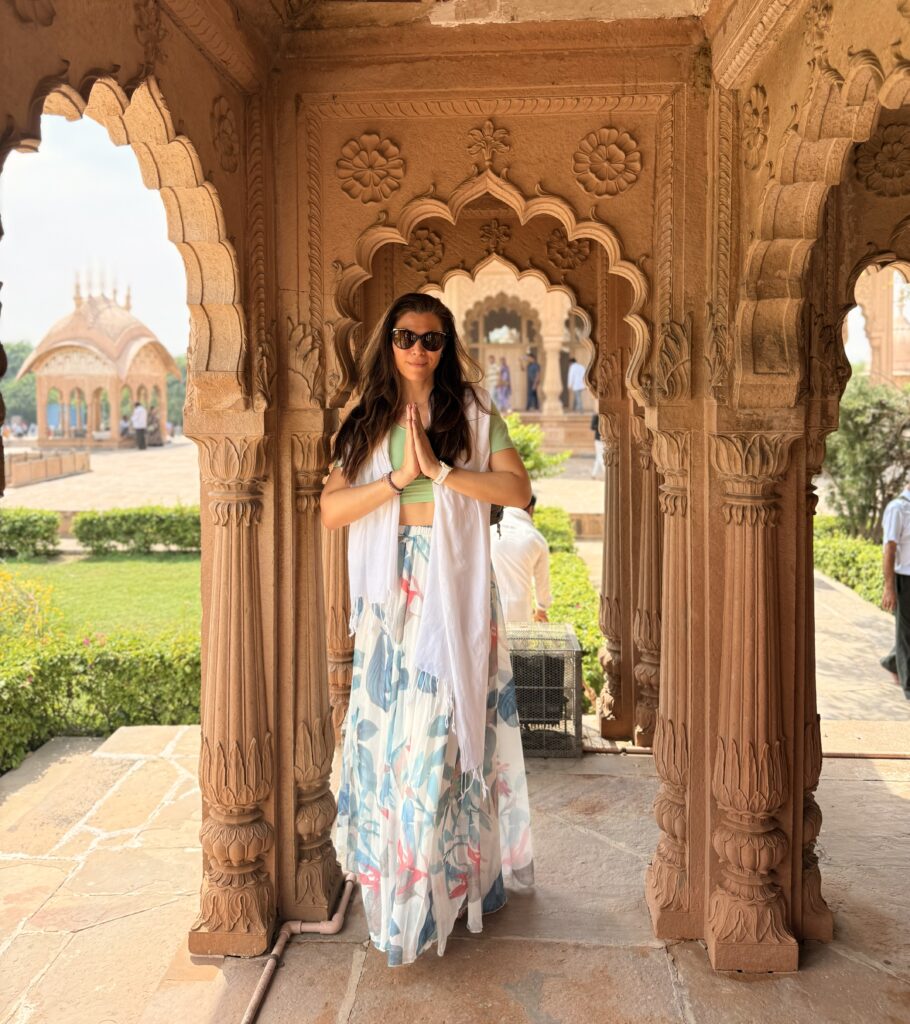
If time allows it, you may want to combine the immersion with a little bit of cultural travel by adding buffer days before and after Vrindavan. It’s easy to explore the Golden Triangle by spending a couple of days sightseeing in Delhi before the immersion, and adding a few days after to visit India’s Pink City of Jaipur.
Radhe Radhe
P.S. Vrindavan is a combination of the words : “Vrinda”, which refers to the sacred Tulsi plant, and “van” means forest.